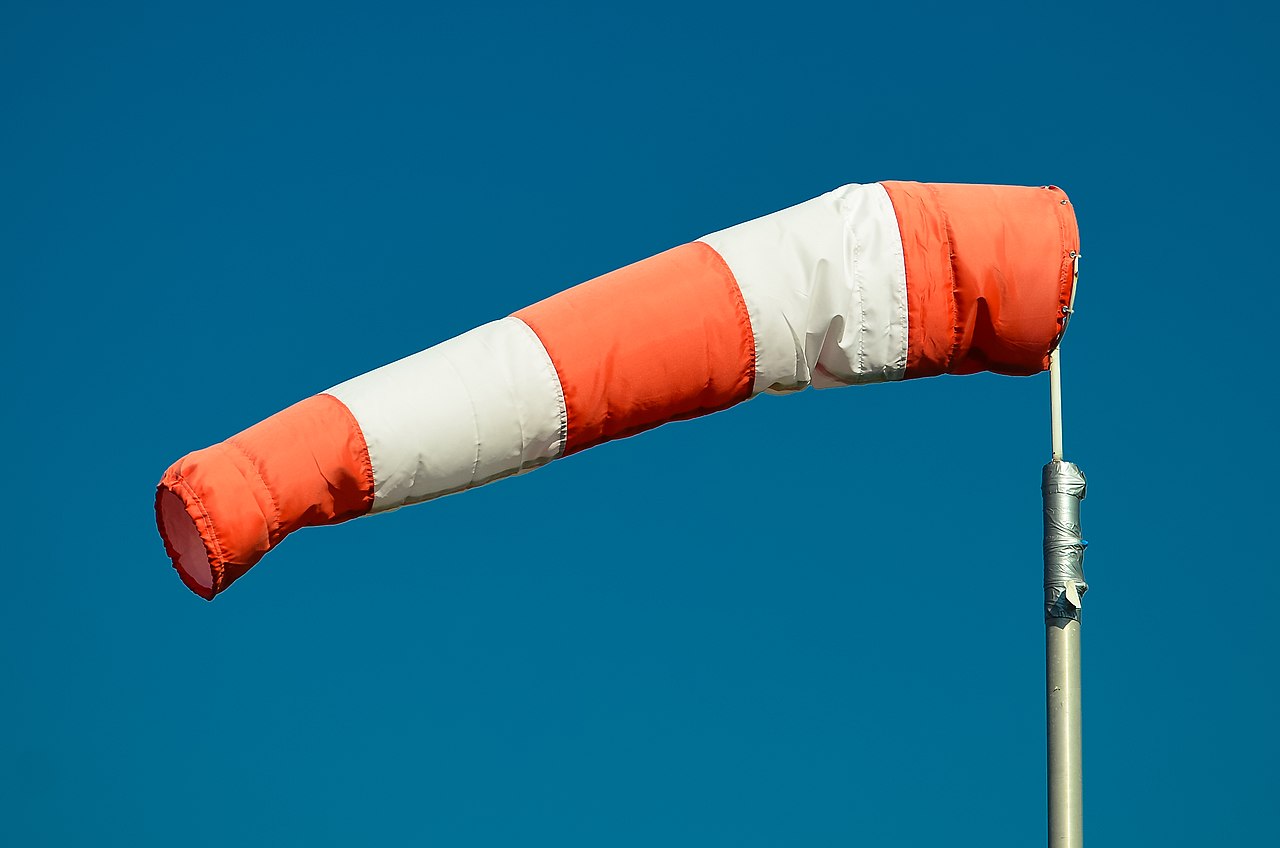
The Red-White Windsock: A Time-Tested Gauge for Wind Strength and Direction
Ever wondered how to quickly gauge wind conditions without relying on complex, electronic instruments? For centuries, simple, visual indicators have played a crucial role in safety and operations across various fields. Among these, the red-white striped windsock stands out as a universally recognized and surprisingly informative device. Far more than just a decorative flag, a properly installed windsock offers immediate, actionable insights into both wind direction and, crucially, its approximate strength. This article delves into the fascinating world of the segmented windsock, teaching you how to "read" its visual cues to understand the invisible forces of the wind.
The Anatomy of a Segmented Windsock: More Than Just a Fabric Cone
At its core, a windsock is a conical textile tube, typically made from a lightweight, weather-resistant fabric. It's mounted on a pivotable mast, allowing it to rotate freely with the wind. The distinctive red and white banding isn't just for aesthetics; it serves a vital purpose: enhanced visibility. Whether viewed from the air by a pilot, from a distance on a bridge, or against a complex background at an industrial site like a biogas plant, these contrasting colors make the windsock easy to spot and interpret, even in varying light conditions.
However, the true ingenuity of the red-white windsock lies in its segmentation. Rather than a plain conical tube, these windsocks are divided into a series of distinct, often equally spaced, red and white rings or segments. These segments are designed to inflate progressively as wind speed increases, providing a clever visual code for approximating wind strength.
Mastering Wind Direction: A Simple Guide
Before delving into wind strength, understanding direction is paramount. Fortunately, a windsock makes this incredibly straightforward. The fundamental rule is simple:
the windsock always points downwind, indicating the direction in which the wind is blowing.
Consider this mnemonic: The wind *comes from* the direction the mast *looks*, and the windsock *points to* the direction the wind *goes*.
For instance, if you observe a windsock pointing directly towards the East, it signifies that the wind is blowing towards the East. Consequently, the wind itself is originating from the West, making it a Westerly wind. The mast, being fixed, acts as the anchor point from which the wind's origin can be easily inferred. Because the windsock rotates freely around its mast, it automatically aligns itself with the prevailing wind, offering a consistently accurate directional reading. This instant visual feedback is invaluable in environments where rapid decision-making is necessary. For a deeper dive into this fundamental aspect, you might find our related article,
How to Read a Windsock: Interpreting Wind Direction & Strength, particularly useful.
Deciphering Wind Strength from Segments: The Visual Code
This is where the segmented design truly shines, offering an ingenious, albeit approximate, method for estimating wind speed. The individual red and white segments are engineered to inflate and extend sequentially as the wind gains force.
Here's the typical "rule of thumb" widely adopted in aviation and other fields, though it's important to note that this is not a universal standard and can vary slightly depending on the windsock's specific design, material, and size:
* Each fully stretched and inflated segment (or ring) is generally considered to represent approximately 3 to 5 knots of wind speed. (For context, 1 knot is roughly 1.85 km/h or 1.15 mph, so 3-5 knots translates to about 5-9 km/h or 3-6 mph per segment).
* Another common approximation suggests counting each fully extended ring as roughly 5 knots or even equating it to one "wind strength" on the Beaufort scale, though this is a very rough estimate given the scale's wider range.
**Practical Interpretation of Segment Behavior:**
* **Limp or Hanging Down:** If the windsock hangs almost entirely limp and shows no signs of inflation, it indicates near-calm conditions or a very light breeze (close to a flat calm).
* **One Segment Stretched:** When only the first segment, closest to the mouth of the windsock, is fully inflated and stretched out, it signals a light, gentle wind.
* **Several Segments Stretched:** If multiple segments are clearly inflated and extended, but not all of them, you are likely experiencing a moderate wind. The more segments that are taut, the stronger the wind.
* **Almost Horizontal, All Segments Stretched Taut:** This is the clearest sign of strong, robust wind. When the windsock is pushed out almost horizontally, with all its segments fully inflated and rigid, it indicates a significant wind force.
Let's consider a vivid example: Imagine you're standing on a bridge, observing a windsock. The mast points South, indicating the wind's origin. The windsock itself is pointing North, showing the wind's direction of travel. Crucially, all its red and white segments are stretched taut and it's almost perfectly horizontal. This visual instantly communicates that a strong Southerly wind is blowing powerfully towards the North. For more detailed insights into this visual code, our
Windsock Guide: Master Wind Direction and Approximate Force article offers further valuable information.
The Practical Value and Inherent Limitations
Windsocks, particularly the segmented red-white variety, are indispensable tools in a multitude of settings:
* **Aviation:** At airports, helipads, and airfields, they provide pilots with crucial pre-flight and landing wind information.
* **Recreational Flying:** Paragliders, hang gliders, and drone operators rely on them for immediate wind checks.
* **Industrial Sites:** Chemical plants, power stations, and biogas facilities use them to monitor potential dispersion of fumes or gases.
* **Bridges and Coastal Areas:** They alert drivers and pedestrians to strong crosswinds or sudden gusts.
* **Construction Sites:** Important for operating cranes and other heavy machinery safely.
* **Maritime:** On docks and piers, they aid in mooring and navigating.
Their value lies in their simplicity, affordability, and reliability. They require no power, operate in all weather conditions, and provide an instant, unambiguous visual cue. They are a critical safety tool, offering a quick assessment when every second counts.
However, it's equally important to acknowledge their limitations:
* **Approximation Only:** Windsocks provide a *gross estimation* of wind strength. They cannot replace the precision of an anemometer or other meteorological instruments. The "knots per segment" rule is a guideline, not a certified measurement.
* **Lack of Standardization:** There's no single, globally standardized calibration for segmented windsocks, meaning the exact wind speed represented by each segment can vary between manufacturers.
* **Local Influences:** Nearby buildings, trees, or terrain can create localized turbulence or wind shadows, affecting the windsock's reading relative to the broader wind conditions.
* **Wear and Tear:** An old, stiff, or torn windsock will not inflate correctly and can give misleading readings.
Despite these limitations, the red-white segmented windsock remains an incredibly effective first-indicator of wind conditions. It serves as a vital complement to more precise instruments, offering an immediate, visual understanding of the invisible force that surrounds us.
Conclusion
The humble red-white striped windsock is a testament to effective, low-tech engineering. By understanding how to "read" its direction and the progressive inflation of its segments, you gain a powerful, immediate insight into the prevailing wind conditions. Whether for safety in aviation, operational awareness in industry, or simply for a greater appreciation of the elements, deciphering the visual language of these segmented windsocks enhances our connection to the environment. The next time you spot one, take a moment to interpret its message – you'll find yourself much more attuned to the fascinating dynamics of the wind.